


The Most Memorable Morning in Tokyo: Discover Authentic Cultural Experiences in the Heart of the Shogun's City
- Shinya Yamada
- 6 days ago
- 9 min read

Imagine beginning your final morning in Tokyo not with a rushed checkout or an anxious taxi ride to the airport.
Not with crowds.
Not with a checklist of sights.
But with the quiet resonance of a centuries-old instrument, the delicate fragrance of hand-crafted wagashi, and an unhurried walk through streets that once belonged to the shogunate.
This is not a fantasy.
This is what awaits you in Kagurazaka — and it begins at 7:30 in the morning.

Why Cultural Experiences in Tokyo's Kagurazaka Are Unlike Anything Else in the City
Tokyo offers no shortage of cultural encounters. Tea ceremonies in Asakusa, sushi masterclasses near Toyosu, sword-forging demonstrations, Noh workshops, kimono photography — the city's cultural calendar is vast and varied.
For the discerning traveler or long-term resident, however, quantity is not the question. The question is depth.
What distinguishes this experience is not that it offers one of these encounters, but that it weaves together a guided walk through living Edo history, a wagashi workshop and tea ceremony with one of Japan's most decorated artisans, and a live performance with a world-class musician — all within a single, unhurried morning of 150 minutes.
It is a cultural "ensemble" found nowhere else in Tokyo: history, craftsmanship, and performing arts, engaged through all five senses, in a setting that almost no visitor to the city ever finds on their own.
Inspired by the world of SHOGUN, this is not a performance to watch.
It is a shogun experience to feel.
The Neighborhood Almost No Visitor Sees
Asakusa draws millions. Shibuya and Shinjuku are synonymous with Tokyo in the global imagination. Even quieter districts — Yanaka, Shimokitazawa — have found their way into mainstream travel guides.
Kagurazaka has not.
And yet it may be the single most historically layered and culturally intact neighborhood in the entire city.
It was here that Tokugawa Ieyasu, Japan's first shogun, inspected the land in 1590 — guided by a local figure named Iida Kihei, widely regarded as Tokyo's original VIP host. In 1595, Ieyasu founded Bishamonten Zenkokuji Temple here. By 1636, under the third shogun Tokugawa Iemitsu, the main Kagurazaka street had been formally developed into one of Edo's most distinguished samurai districts.
Over the centuries that followed, the neighborhood became home to samurai residences, then literary salons, then geisha quarters. It survived the Great Kanto Earthquake of 1923 with relatively little damage — drawing merchants and artists who transformed it into one of Tokyo's most vibrant cultural centres, earning it the nickname "Yamanote Ginza." Its residents have included novelist Natsume Soseki, filmmaker Akira Kurosawa, and master performer Michio Miyagi.
Today, its maze-like cobblestone alleys remain — not as a museum exhibit, but as a living environment where tradition and cosmopolitan elegance coexist with quiet confidence.
Most visitors to Tokyo will never walk these streets.
This experience exists to change that.

A Morning Composed Around All Five Senses
This 150-minute experience is deliberately limited to just eight guests per session. Every element has been composed to engage sight, sound, taste, smell, and touch — creating not a tour, but a complete sensory journey through Edo.
Sight — A Walk Through the Shogun's District (7:30–8:20 AM)
The morning begins at JR Iidabashi Station (West Exit), where your guide leads you through the quiet early streets of Kagurazaka before the city has fully awakened. The stone-paved alleys, the latticed facades of old ryotei, the temple gates still draped in morning mist.
This is not a standard Tokyo morning tour. The route is carefully framed through the lens of Edo-period urban history, samurai culture, and the administrative legacy of the Tokugawa shogunate — offering a depth of knowledge you simply will not find in a guidebook or a group bus tour.
Your guide does not merely point out landmarks.
They invite you into a conversation with history.
Imperial Craftsmanship — Wagashi & Tea Ceremony (8:20–9:10 AM)
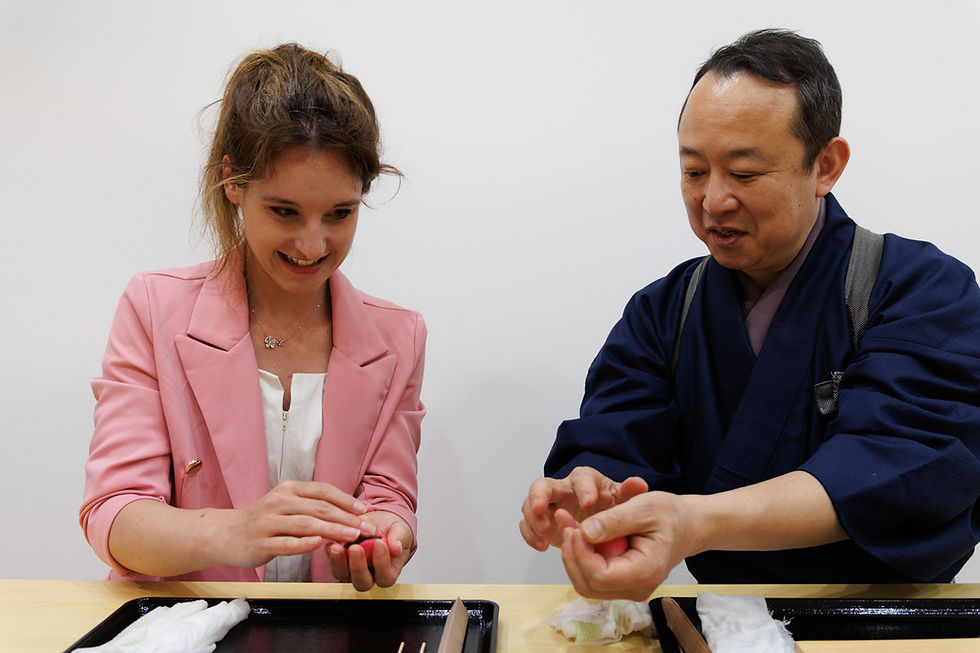
From the streets of Kagurazaka, you step into Fufumian — the private annex of Baikatei, a sanctuary usually closed to the public. The atmosphere shifts immediately: the scent of freshly prepared ingredients, the precision of a workspace where every detail has been considered.
Here, you meet Takeshi Inoue — and he is not merely a confectioner.
He is a certified Tokyo Meister, a distinction awarded by the Governor of Tokyo to craftsmen who represent the absolute highest standard of their discipline. He holds the designation of Outstanding Wagashi Artisan — among the most prestigious honours in the field. His workshop supplies the Imperial Household. He has received the tea name "Sogo" from Grand Master Zabosai of the Urasenke school of tea.
Under his guidance, you will craft seasonal Japanese confectionery — wagashi — with your own hands. Not merely learning a technique, but engaging a philosophy:
What does it mean to create something beautiful, only for it to be consumed and disappear?
The session concludes with a refined tea ceremony, in which the sweets you have crafted are enjoyed in stillness, alongside matcha — exactly as they were intended to be.
To sit across from a craftsman of this calibre, in his own intimate space, with just eight guests, is a privilege of a kind that simply cannot be arranged independently.

The Soul of the Kokyu — Performance & Experience (9:10–10:00 AM)
The morning concludes in a different register entirely.
With sound.
The kokyu is a bowed string instrument from the Edo period — one of the rarest and least-known of Japan's traditional instruments. Its voice is subtle, intimate, and deeply affecting. Closer in spirit to the human breath than to any Western instrument. In the hands of a master, it seems to draw something out of the silence itself.
Your performer is Daisuke Kiba, one of Japan's foremost kokyu virtuosos. A regular at the National Theatre, a recipient of recognition from the Agency for Cultural Affairs Arts Festival, and a frequent presence on NHK — his artistry has reached global audiences in ways few could have anticipated. He contributed to the soundtrack of the Emmy Award-winning Hollywood drama *SHOGUN*, and has performed as a guest artist in concerts by Grammy Award-winning singer Alicia Keys.
If the music of SHOGUN left an impression on you — that sense of something ancient and deeply human speaking through the score — this is your opportunity to hear that voice performed live, just a few feet away, and to hold the instrument in your own hands.
The session includes a full live performance inspired by samurai themes, a cultural conversation about the kokyu's history and significance, and a guided hands-on introduction to the instrument.
It is a rare and quietly extraordinary way to end a morning.

Exceptional Value and Strategic Elegance
In Tokyo's cultural experience market, private access to a single master artisan or performer typically commands ¥30,000 to ¥50,000 per person — and exclusive encounters such as sumo stable visits or private geisha banquets can reach considerably higher.
This program — bringing together a guided walk through Edo history, an imperial-level wagashi and tea experience, and a private kokyu performance and interaction with one of Japan's most celebrated virtuosos — is offered at:
JPY 17,000 per person (tax included)
This is not a compromise.
It is a carefully curated cultural offering, designed to deliver exceptional depth within a single morning.

Who This Experience Is For
This experience is ideal for:
- Culturally curious travelers seeking depth beyond sightseeing — particularly those departing Tokyo in the afternoon, as most international flights leave between 16:00 and 18:00, leaving the morning beautifully open
- Residents in Japan looking for rare, intimate access to cultural practitioners at the very top of their fields
- Those inspired by SHOGUN who wish to encounter the world of Edo not on screen, but in person
Whether you are visiting Tokyo for the first time or have lived here for years, this is an experience that reveals a side of Japan rarely encountered — and even more rarely forgotten.
After the Tour — A Full Day of Cultural Discovery in Kagurazaka
The SHOGUN Cultural Experience concludes at 10:00 AM — precisely when Kagurazaka begins to come alive. What follows is entirely your own. But for those who wish to continue, the district offers a remarkable concentration of traditional cultural experiences in Tokyo, each one worthy of its own morning.
Your guide is available to lead you personally through the area and make introductions where appropriate.
Century-Old Shops and Artisan Boutiques
Kagurazaka's historic shopping street is home to establishments that have endured for generations. Sukeroku offers hand-crafted traditional footwear; Rakuzan is a refined destination for premium matcha and loose-leaf tea; Tsubakiya carries hand-painted folding fans; Maruoka Toen and Toushien are celebrated for their ceramics; and Soumaya stocks exquisite Japanese stationery.
Many of these stores carry items unavailable elsewhere in Tokyo — and their proprietors bring a depth of knowledge that transforms a shopping visit into a cultural education of its own.

Kumihimo Braiding at Domyo
At Domyo, one of Tokyo's most distinguished purveyors of traditional braided cord, guests may participate in a kumihimo workshop — the ancient Japanese art of interlacing silk threads into intricate, patterned cords. Once used to secure samurai armour and adorn the hilts of swords, kumihimo is today both a meditative craft and a living link to the Edo period. A hands-on session here is a natural extension of the morning's themes.

Zen Meditation at Denchuji Temple
For those seeking stillness after the sensory richness of the morning, Denchuji Temple offers a guided Zen meditation session in an atmosphere of genuine contemplative depth. Zazen — seated meditation in the Zen tradition — has been practiced in Japan for centuries as a means of cultivating presence and clarity. Under the guidance of an experienced instructor, even first-time practitioners find the experience quietly transformative.

Ukiyo-e Woodblock Printing at Takahashi Kobo
The Edo period gave the world ukiyo-e — the woodblock print tradition that produced some of the most recognizable images in all of Japanese art. At Takahashi Kobo, guests work directly with master printmakers to create their own woodblock print, using traditional tools and pigments in a process largely unchanged for three centuries. The result is not merely a souvenir, but a hand-made artwork carrying the specific imprint of a single afternoon in Kagurazaka.

Noh Theater at Yarai Noh Theater
A short walk from the main street, Yarai Noh Theater is a Registered Tangible Cultural Property and one of the few functioning Noh stages in central Tokyo. Visits and experiential programs offer a rare encounter with Japan's oldest surviving theatrical tradition — a form of performance art that has been practiced, largely unchanged, since the 14th century. To stand on a Noh stage, or to watch a rehearsal in this intimate setting, is to encounter Japanese culture at its most austere and profound.

A Geisha Banquet Lunch at Shimakin
From 11:00 AM, for those who wish to conclude their Kagurazaka experience in the grandest possible style, a private geisha banquet lunch may be arranged at Shimakin — a celebrated eel restaurant with deep roots in the neighborhood's geisha culture. The combination of exquisite kaiseki-influenced cuisine, the refined hospitality of Tokyo's remaining geisha, and the atmosphere of a traditional Kagurazaka ryotei represents one of the most complete expressions of Japanese hospitality available anywhere in the city.

The Ideal Conclusion to Your Journey
For international travelers, this experience concludes at 10:00 AM — leaving the entire afternoon free for a relaxed transfer to Narita or Haneda, with time for a final lunch in Kagurazaka and unhurried browsing of its historic streets.
Most long-haul flights depart Tokyo between 16:00 and 18:00. This morning was designed with precisely that window in mind: a meaningful farewell to Japan, rather than a waiting room.

For Residents of Tokyo: Access That Even the City Cannot Easily Offer
If you live in Japan, you may know Kagurazaka well. You may have walked its alleys, dined in its restaurants, admired its quiet atmosphere.
But this experience offers something that even long-term residents rarely encounter: direct, intimate access to two of the city's most distinguished cultural practitioners, in a setting curated for depth rather than scale.
Whether you are welcoming international guests and wish to offer them an encounter with Japanese culture that transcends the standard tour — or seeking a singular experience for yourself, a morning that reminds you why you chose to make your life in this country — this is that morning.
Practical Information
Dates: Sunday, June 21 / Sunday, July 12, 2026
Time: 7:30 – 10:00 AM
Meeting Point: JR Iidabashi Station (West Exit)
Price: JPY 17,000 (Tax included)
Group Size: Maximum 8 guests per session
Reserve Your Place
A quiet and refined morning in Tokyo — where history, culture, and the spirit of the shogun come together.
Only eight seats per session.
Once they are filled, they are gone.
For inquiries or private group arrangements, please contact us directly.
The SHOGUN Cultural Experiences is offered by EDO KAGURA Corporation, a luxury travel company dedicated to connecting discerning travelers and residents with the authentic cultural heritage of Japan.
This project is supported by a grant from the Tokyo Metropolitan Government and the Tokyo Convention & Visitors Bureau for the promotion of nighttime tourism. |


Comments