


Spanish Speaking Guide in Tokyo: Kagurazaka Walking Tour Connecting Samurai and Don Quixote
- Shinya Yamada
- Feb 23
- 7 min read

Kagurazaka remains one of Tokyo’s least-known historic districts among international travelers. Yet walking through this neighborhood is far more than sightseeing. It is a cultural experience that allows you to examine the similarities and differences between two civilizations that flourished in the 17th century while choosing very different paths.
In 1636, Kagurazaka-dori was developed under Tokugawa Iemitsu, the third shogun of the Edo period. Around the same era in Spain, Madrid’s Plaza Mayor was completed (1619), and Miguel de Cervantes published Don Quixote (Part I in 1605, Part II in 1615).

During this period, Japan consolidated internal order under the shogunate, while Spain expanded outward as a maritime empire.
Separated by the vast Eurasian continent, Japan in the Far East and Spain on the Iberian Peninsula each shaped its own aesthetic and moral civilizational ethos — what Japan calls “Michi,” a cultivated way of being.
As you walk the cobblestone streets of central Tokyo’s Kagurazaka, you may sense echoes of Bushido and Chivalry, the silent elegance of geisha dance and the emotional intensity of Flamenco and Tango, and a shared appreciation for festivals and gastronomy.

For travelers seeking a Spanish speaking guide in Tokyo, Kagurazaka offers both familiarity and discovery — a place where cultural parallels emerge, yet a uniquely Japanese aesthetic remains unmistakable.
This article explores six cultural connections between Kagurazaka and the Spanish-speaking world through the symbolic figures of the Shogun and Don Quixote.
This is not simply a walk. It is an intellectual journey where civilizations meet.
Welcome to Kagurazaka.

Table of Contents
The Cobblestone Streets: A Human-Scale City
Dance as Emotional Expression: Flamenco, Tango, and Geisha Nihon Buyo
Chivalry and Bushido: The Spirit of “Iki”
A Shared 17th Century: The Shogun and Don Quixote
Gastronomy: Tradition and Innovation in Dialogue
Festivals and the Joy of Life
1. The Cobblestone Streets: A Human-Scale City
Kagurazaka’s back alleys are paved with stone, giving it the atmosphere of a preserved old quarter. Because of its refined aesthetic and historic entertainment district heritage, it is sometimes referred to as “Little Kyoto of Tokyo.”

According to local accounts, the stones were laid so that geisha could walk to ryotei (traditional restaurants) without soiling their kimono on muddy roads. One of the first sections was reportedly paved in front of the historic ryotei Yukimoto.
Famous alleys such as Kakurenbo Yokocho (“Hide-and-Seek Alley”) and Hyogo Yokocho retain this character. In Kakurenbo Yokocho, a single heart-shaped stone is embedded in the pavement. Without guidance, it is almost impossible to find — yet visitors often take great pleasure in discovering it.

Across Spain and Latin America, cobblestone streets define historic districts — from Plaza Mayor in Madrid to Guanajuato (Mexico), Cusco (Peru), Cartagena (Colombia), and Colonia del Sacramento (Uruguay). While such streets exist throughout Europe, they are rare in modern Tokyo, where asphalt dominates.
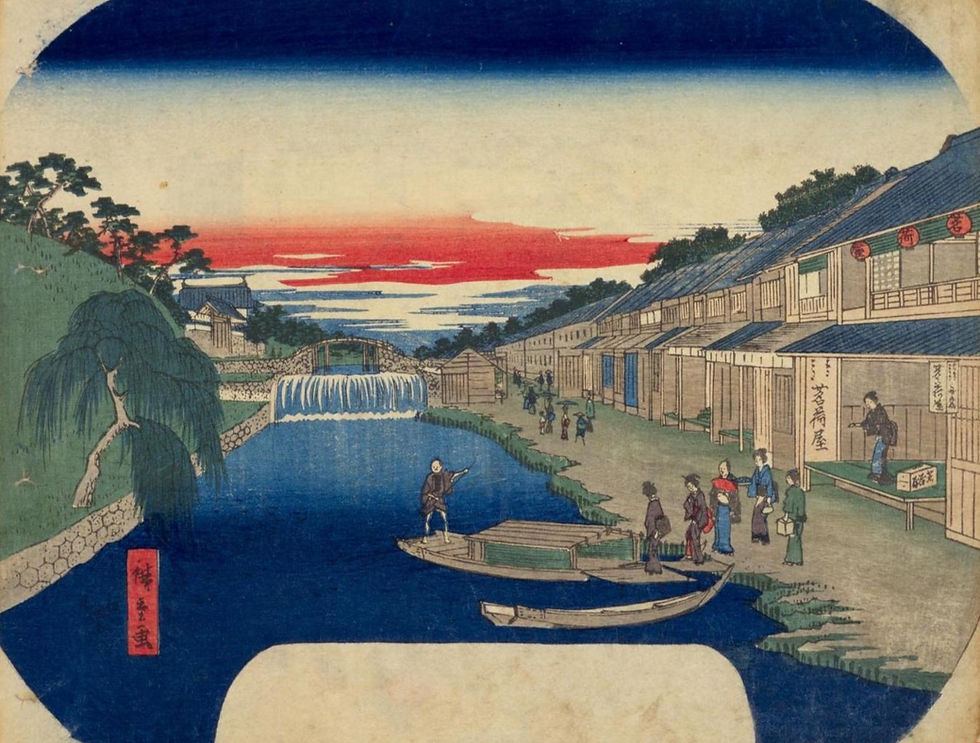
Kagurazaka preserved its Edo-period street layout partly because it sits on elevated ground and suffered relatively limited destruction during the 1923 Great Kanto Earthquake. As a result, visitors can still walk routes that follow the urban plan of the Edo period (1603–1868).

It remains a district built at a human scale — designed for walking rather than automobiles. Kagurazaka Street is even said to have hosted one of Tokyo’s earliest pedestrian initiatives in 1887 (NHK documentary source).
2. Dance as Emotional Expression: Flamenco, Tango, and Geisha Nihon Buyo
Flamenco in Spain and Tango in Argentina are powerful forms of emotional storytelling. Though Flamenco is primarily a solo art marked by rhythmic footwork (zapateado), and Tango is an intimate partner dance, both express love, sorrow, longing, and passion through the body.
Kagurazaka’s geisha preserve Nihon Buyo — a classical Japanese dance form rooted in Kabuki tradition and registered in 2023 as an Important Intangible Cultural Property of Japan.
Flamenco, Tango, and Nihon Buyo share a key physical technique: a lowered center of gravity. Unlike classical ballet, which emphasizes upward extension, these traditions ground the body, drawing strength from stillness and tension.
Despite this shared foundation, their aesthetic conclusions differ:
Flamenco: an explosion of individual passion
Tango: a dialogue between partners
Nihon Buyo: refined elegance within restraint
Geisha dance may appear subtle, but its storytelling power lies in disciplined gestures — especially the hands and fingertips, where emotion is distilled into minimal movement.
For travelers accompanied by a Spanish speaking guide in Tokyo, these parallels often deepen appreciation beyond surface observation.
3. Chivalry and Bushido: The Spirit of “Iki”
While districts like Asakusa developed as merchant towns, Kagurazaka was historically a samurai residential area within the Yamanote (upper-class) zone of Edo.
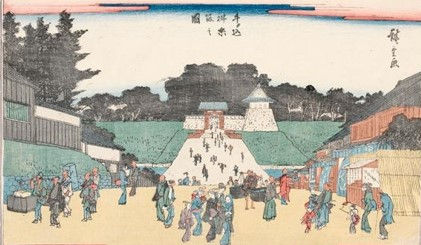
Spain developed the moral code of chivalry; Japan cultivated Bushido. Both originated in warrior cultures, yet diverged in ethical emphasis. Chivalry evolved within a Christian framework and often included devotion to a noble lady. Bushido developed under Confucian influence, emphasizing honor, loyalty, and personal integrity.
Although samurai no longer exist, Kagurazaka retains the aesthetic known as Iki — a form of refined understatement. Iki does not rely on excess decoration but on controlled posture, modesty, and disciplined movement.
In long-established shops and artisan workshops, some operating for over a century, visitors may sense this inherited spirit of quiet dignity.

4. A Shared 17th Century: The Shogun and Don Quixote
Kagurazaka’s development overlaps with Spain’s Golden Age.
Tokugawa Iemitsu completed Kagurazaka-dori in 1636, 46 years after Tokugawa Ieyasu entered Edo in 1590. Ieyasu is widely known as the historical model for Yoshii Toranaga in the recent television series SHOGUN.
Meanwhile, Spain stood at the height of its Golden Age under Philip II and Philip III. Plaza Mayor rose in Madrid in 1619 as a symbol of imperial self-assurance. In this same period, Miguel de Cervantes published Don Quixote (Part I in 1605, Part II in 1615) — a work now circulated in over 500 million copies worldwide — offering a profound and ironic meditation on the waning ideals of medieval chivalry. It endures as one of the foundational texts of modern literature.

In 1624, Japan formally severed diplomatic relations with Spain as part of policies that later evolved into national seclusion. While Spain expanded globally, Japan chose internal consolidation.
The two nations briefly intersected in history — then selected different futures. The more than two centuries of relative isolation allowed Japan to refine its internal cultural aesthetics, including the “Iki” sensibility preserved in Kagurazaka.
Understanding this historical divergence adds depth to a walking tour guided by a Spanish speaking guide in Tokyo, who can contextualize these shared timelines.
5. Gastronomy: Tradition and Innovation in Dialogue
Within a radius of approximately 800 meters from Kagurazaka Station, there are 1,196 restaurants (Tabelog data). As of Michelin Guide Tokyo 2026, 21 restaurants in this small area are Michelin-listed. This represents approximately 1.76% of establishments — a higher ratio than districts such as Ginza (1.23%) and Ebisu (0.88%).

Spain, likewise, is a global gastronomic leader, with 307 Michelin-starred restaurants listed in the Michelin Guide Spain 2026.
In the Spanish-speaking world, Lima has emerged as a culinary capital. In The World’s 50 Best Restaurants 2025, four Lima restaurants were ranked (Maido, Kjolle, Mérito, Mayta), with Maido placed #1. Tokyo had three restaurants in the same ranking.

Maido specializes in Nikkei cuisine — a fusion of Japanese and Peruvian traditions — demonstrating how cultural dialogue generates innovation.
Kagurazaka reflects a similar balance between tradition and evolution. The district is also home to over 100 bars, many opening in the afternoon. Sanlucar BAR, often cited as one of Tokyo’s highest-rated bars, opens at 2:00 PM. While reservations can be challenging, local knowledge makes timing more strategic than luck.

6. Festivals and the Joy of Life
Festivals are central to many Spanish-speaking cultures, and Kagurazaka is one of Tokyo’s most active festival districts.
February – Setsubun: At Zenkoku-ji Temple (Bishamonten), geisha and residents participate in bean-throwing ceremonies. On this occasion, geisha appear in playful disguises.

May – Kagurazaka Machi Butai Oedo Meguri: Traditional performing arts appear in streets and courtyards, including Edo Daikagura, Tezuma (Japanese classical magic), Shin-nai narrative music, geisha performances, and Noh at Yarai Noh Theater.

July – Kagurazaka Matsuri: The main street fills with Awa Odori dancers, a tradition introduced in 1972 with historical ties to the Tokushima domain.

October – Bakeneko Festival: Inspired by Natsume Soseki’s novel I Am a Cat, participants parade in elaborate cat costumes — reminiscent, in spirit, of Mexico’s Día de Muertos in its joyful embrace of disguise and performance.

Notably, the Kagurazaka Bakeneko Festival will gain international attention with the release of the Hollywood film Rental Family, starring Brendan Fraser, on February 27, 2026. The film features the festival as one of its cultural highlights.
The 2026 Kagurazaka Bakeneko Festival itself is scheduled to take place on Sunday, October 11, 2026.
Conclusion: Walk Kagurazaka with Our Spanish Speaking Guide in Tokyo
Just ten minutes from Kagurazaka lies Instituto Cervantes Tokyo, a major global center for Spanish language and culture. Its proximity feels symbolically fitting in a district where the timelines of Japan and Spain once overlapped.
We hope this article provides a meaningful reason to visit Kagurazaka. If you wish to explore these cobblestone streets with historical depth and cultural context, our professional Spanish speaking guide in Tokyo will be pleased to accompany you.
Kagurazaka is not merely a neighborhood. It is a meeting point of traditions, aesthetics, and histories shaped by different choices — yet connected by shared human themes.
We look forward to welcoming you.

Book Kagurazaka Walking Tour
How to Access Kagurazaka
The Kagurazaka area is conveniently located within 30 minutes from any major station in Tokyo. This is because Kagurazaka is situated in the heart of Tokyo, at the center of the Yamanote Line. Please come and visit this convenient and charming Kagurazaka.


Comments