


The History of Manga: Why was manga born in Japan? — Edo’s constraints created it, and Tokyo nurtured it
- Shinya Yamada
- Mar 24
- 4 min read
Updated: Apr 30

Today, "Manga" has become a universal language loved across borders and generations. It accounts for a staggering 43.5% of the Japanese publishing market (print + digital, 2023, Source: Research Institute for Publishing Science) and has established a dominant presence globally, including North America, Europe, and Asia.
However, when we truly explore the history of manga, a single fundamental truth emerges. Manga did not arise naturally in a world of "freedom." Instead, it was born within the "constraints" of the Edo period, shaped by "necessity," and later flourished in post-war Tokyo—again, under a different kind of constraint.
Here, we explain the 800-year journey of how the Japanese manga market grew to lead global publishing culture.
The DNA of Visual Storytelling — The Choju-giga and the History of Manga
The roots of the history of manga can be traced back to the 12th-century Choju-jinbutsu-giga (Scrolls of Frolicking Animals and Humans). In these scrolls, frogs, rabbits, and monkeys are anthropomorphized, moving with vitality across a narrative timeline.

The fundamental concept of "telling a story through images," which continues into modern manga, already existed here. However, this form of expression would not explode into a mass cultural phenomenon until several centuries later, during the Edo period.
"Affordable Media" and the Aesthetics of "Iki" — A Revolution Born of Necessity
During the Edo period, manga was born as a "form of media for the common people." At its core were strict "constraints" imposed by the Tokugawa shogunate.
The "Sumptuary Laws" and the Aesthetics of Subtraction
The shogunate enforced "Sumptuary Laws" (Shashi Kinshi-rei) to strictly limit luxury among the common people, banning flashy colors and expensive materials. Rather than suppressing creativity, these constraints led to innovation. People refined an aesthetic that eliminated excess and emphasized essence—a uniquely Edo sense of understated sophistication known as "Iki."

The Economic Constraint: "16 Mon per Ukiyo-e" (Approx. USD 3)
The price of a single Ukiyo-e print was controlled to be around the cost of a bowl of soba noodles (16 mon). To achieve such affordability, a highly efficient division of labor was established. Rather than "one-of-a-kind fine art," it became mass-produced visual media.

This environment refined the simple, powerful "line" expression found in modern manga. Because it was necessary to use mountain cherry wood (Yamazakura)—a hard and expensive wood—it was essential to minimize the number of printing blocks to keep costs down. The defining characteristics of manga—abstraction and simplification of reality—originated from these Ukiyo-e prints created out of sheer necessity.
Born from "Urgent Need" — The Hokusai Manga
Within this Edo cultural context, Katsushika Hokusai popularized the term "Manga." His reason for drawing the Hokusai Manga was not driven by artistic idealism, but by a very practical, real-world problem.

As Hokusai became a popular artist, he was flooded with students wanting to apprentice under him. However, he lacked the time to teach each person individually. He thought: "If I cannot provide individual instruction, I will create a manual they can learn from."

Thus, out of necessity, he produced a collection of illustrated manuals (E-tehon)—over 3,000 sketches capturing human movement and daily life through concise lines. This process—observe, extract essence, and express through line—is identical to modern manga creation. It is also important to recognize that these works were largely monochrome because full-color printing was far too costly for a mass-market textbook.

Post-War Era — "For Children" as the Only Freedom
After acquiring modern formats during the Meiji and Taisho periods, the history of manga reached its greatest turning point after World War II. In the devastated post-war landscape, many forms of expression were restricted. However, children’s culture remained relatively free from strict censorship.
Consequently, the creative energy of many artists poured into affordable media such as Kamishibai (paper theater), Akabon (red books), and Kashibon (rental books). While it was difficult for adults to openly discuss society, storytelling for children was permitted. This situational constraint caused a massive concentration of talent within the field of manga.
Osamu Tezuka and the Revolution of Storytelling
From this environment emerged the "God of Manga," Osamu Tezuka. In works like New Treasure Island (1947) and Astro Boy (1951), he introduced cinematic camera work (zooms and close-ups), evolving manga into an "immersive story."
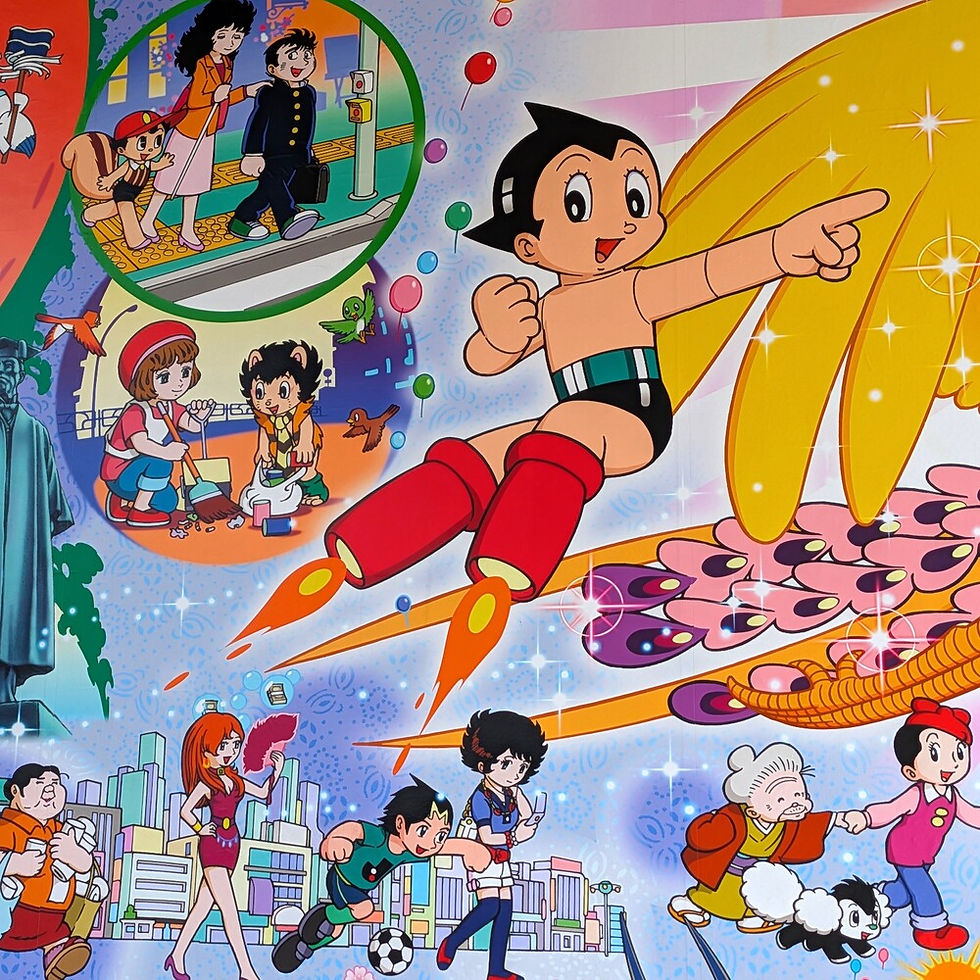
Tezuka’s works offered hope for the future, something essential for people living in the aftermath of war. The concept of a humanoid robot in Astro Boy later influenced global hits like Doraemon and Mobile Suit Gundam.
The Chain of Creation — Takadanobaba and Tokiwaso
The foundation established by Tezuka was refined at a "dojo" in Tokyo called "Tokiwaso." This was not just an apartment building; it was a manga training hall where young artists like Fujiko F. Fujio and Shotaro Ishinomori lived and competed.
Interestingly, Tokiwaso was also born from necessity. Editors needed a system where artists could quickly assist one another to meet deadlines, and creators sought any opportunity to sell their work—even as substitutes.
Tezuka’s production company, "Tezuka Productions," is still located in Takadanobaba, Tokyo. The Astro Boy melody playing at the station is a symbolic echo of this history. Our own office is also located here, where we experience this cultural continuity firsthand.

Why Did Manga Develop So Strongly in Japan?
From a neuroscience perspective, the Japanese writing system allows the brain to process "text" and "pictures" (Kanji as pictograms) in different areas simultaneously. The Japanese language itself contains a structure similar to manga.
The simplification forced by Edo’s cost-cutting, Hokusai’s "necessity" to create teaching materials, the post-war market's demand for children's content, and the rivalry at Tokiwaso—all these factors converged. Manga was not a coincidence; it was the inevitable result of layered historical forces.
Conclusion: Experience the Roots of Manga
The next time you open a manga, remember the human ingenuity and urgent necessity behind every single line. Once you understand it, the next step is to experience it.
See: Sumida Hokusai Museum. Hosting a 10th-anniversary exhibition (March 17 – May 24, 2026). Experience the raw lines Hokusai created out of necessity.
Walk: Takadanobaba and Tokiwaso Pilgrimage. Visit the town of Osamu Tezuka and the legendary Tokiwaso. Nearby, explore the anime mecca, Animate Ikebukuro Main Store.
Create: Ukiyo-e Printing Experience at Takahashi Kobo. Experience the aesthetic born from the "16 mon" constraint. By printing The Great Wave off Kanagawa yourself, you will physically understand the roots of manga.
Manga is not mere entertainment. It is the pinnacle of expression achieved over centuries of Japanese culture—an art form that transforms constraint into creative power.


Comments