


Tokyo in January 2026: The Journey That Best Reveals Japan’s Living Traditions — Weather, Crowds, and Culture
- Shinya Yamada
- Dec 24, 2025
- 6 min read
Updated: 5 days ago

January is often overlooked as a time to visit Tokyo.“It must be too cold,” or “Many places are probably closed for the New Year”—these assumptions cause many travelers to rule it out.
Yet when we examine climate data, accommodation statistics, and Japan’s seasonal calendar carefully, a different picture emerges. With the right expectations, January is one of the most rational—and culturally revealing—times to experience Tokyo. It is also the month when Japanese people incorporate traditional customs most deeply into everyday life.
This article moves beyond impressions and travel clichés. Using concrete data, social systems, and seasonal rituals, it examines why January offers a uniquely clear window into contemporary Japanese culture.
Tokyo in January: Weather, Stability, and What the Data Really Shows
January is the coldest month of the year in Tokyo.
Average minimum temperature (2010–present): 1.9°C (35°F)
Average temperature: 5.8°C (42°F)
Within Japan’s traditional calendar—known as the 24 sekki and 72 microseasons—the coldest period, Daikan (“Great Cold”), lasts from January 20 to February 3 in 2026. This is followed by Risshun, the beginning of spring, which starts on February 4.
Average Temperature and Humidity in Tokyo (2010–2024 )

Source: Japan Meteorological Agency
However, temperature alone does not determine whether a city is comfortable to visit. What matters more is weather stability.
Monthly average precipitation: 45 mm (the lowest of the year)
Sunshine rate: 65.1% (the highest of the year)
Monthly average precipitation and Sunshine rate in Tokyo

Source: Japan Meteorological Agency
These figures show that January in Tokyo is cold, yet remarkably stable from a weather perspective. Unlike northern Japan, where snowfall is routine, snow in Tokyo is rare, and the city’s transportation and urban life continue to function normally throughout the month.
This also addresses two common questions travelers often ask. How cold does Tokyo feel in January? Cold, but generally manageable with proper clothing.
Does it snow in Tokyo during January? Occasionally, but rarely enough to interfere with sightseeing or travel plans.
Winter Clarity: When Tokyo Is at Its Most Visible
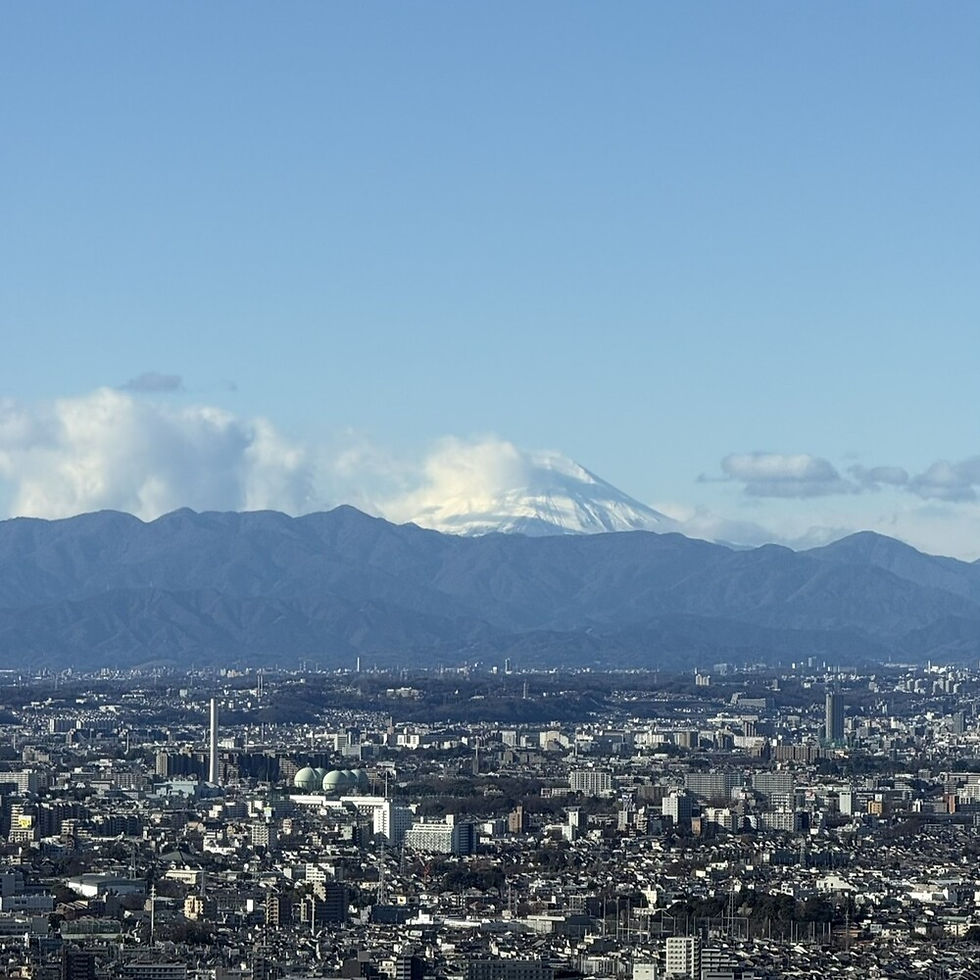
Dry winter air reduces moisture and dust, producing the clearest skies of the year. As a result, January offers the best conditions for seeing Mount Fuji from central Tokyo.
One of the most accessible viewpoints is the Tokyo Metropolitan Government Building Observation Deck in Shinjuku.
Height: 202 meters
Regular hours: 9:30 a.m.–9:30 p.m.
Admission: Free
On January 1, 2026, the observation deck will be open from 7:30 a.m. to 5:30 p.m. without a reservation. On clear days, Mount Fuji is clearly visible to the west.
What to Wear in Tokyo in January (and What You Don’t Need)
Travelers often worry about clothing in midwinter Japan. In practice, the requirements are straightforward.
Down jacket or thick coat: essential
Gloves and scarf: recommended
Layering: essential (indoor heating is strong)
Waterproof boots: unnecessary (snow is rare)
From a local perspective, the greater challenge is not the cold itself but the sharp temperature contrast between indoors and outdoors. Layered clothing that can be easily removed is essential—an approach that answers most practical questions about what to wear when visiting Tokyo in January.
January as a Social System: New Year Closures and Travel Realities
The main complexity of January travel in Tokyo is not the climate, but the New Year holiday.
January 1–3 (the first three days of the year)
Small, independently owned restaurants: often closed(many observe year-end holidays from Dec 27 to Jan 4 in 2025–26)
Major shrines and temples (Meiji Shrine, Senso-ji): extremely crowded
Tourist souvenir shops: generally open
After the holidays (2026)
First workday: Monday, January 5
January 3–4: heavy congestion on trains and highways due to return travel
In short, January travel succeeds or fails based on timing and location selection.
Coming-of-Age Day Ceremony: A National Ritual in Transition
By mid-January, Tokyo’s streets fill with young people in formal kimono for Japan’s Coming-of-Age Day (Seijin no Hi), a national holiday marked by local Coming-of-Age Day Ceremonies that celebrate the transition into adulthood.
Although Japan lowered the legal age of adulthood from 20 to 18 on April 1, 2022, most municipalities still celebrate coming of age at 20. As a result, the event is increasingly referred to not as Seijin-shiki (Coming-of-Age Ceremony), but as “Gatherings for Twenty-Year-Olds.”
Only a handful of municipalities hold ceremonies at 18, including:
Iga City, Mie Prefecture
Kunisaki City, Oita Prefecture
Misato Town, Miyazaki Prefecture
Coming-of-Age Day in 2026
National holiday: Monday, January 12
Most ceremonies are held on Sunday, January 11, or Monday, January 12
Even as laws change, the persistence of this ritual shows how Japanese society continues to protect symbolic transitions into adulthood.

Why January Is Tokyo’s Quietest Month
Statistics confirm what travelers often sense intuitively.
Foreign overnight stays in Tokyo in January: 72% of the annual average (the lowest level)
December: 115% (one of the highest months)
This sharp drop after the New Year leads to:
Less crowded attractions
Lower hotel prices
A calmer overall atmosphere
The idea that January is “quiet and relatively affordable” is not an impression—it is supported by data.
Monthly Foreign Guest Nights in Tokyo

Source: Japan Tourism Agency’s lodging statistics
Note: Indexed with the annual average set at 100%
Where Traditional Cultural Life Becomes Visible in Midwinter
At this point, a pattern is clear. January favors places that:
Do not rely on long outdoor activities
Maintain cultural rhythms even during holidays
Avoid excessive crowds
Offer experiences limited to this season
When these conditions are applied, one area stands out naturally.
Kagurazaka in January: When the City Shifts into New Year Mode
Located in central Tokyo, Kagurazaka is unusual. It is not a tourist district, but a neighborhood where geisha culture and seasonal rituals continue as part of daily life.
In January, the change is subtle but unmistakable. Decorations are restrained; instead, people’s appearance and behavior shift, signaling the New Year.
New Year Attire of Geisha: A Rare Seasonal Appearance
Unlike Kyoto, Tokyo geisha do not normally wear white makeup. However, until around January 20, Kagurazaka geisha appear in formal New Year attire:
White makeup
Black hikigi kimono (the most formal kimono)
This appearance is strictly seasonal and tied to the New Year alone.

Rice Ear Hairpins: Practical Wishes for the New Year
During this period, geisha wear hairpins decorated with rice ears, a symbol of harvest and prosperity. In Kagurazaka and other geisha districts, it is still said that receiving a few grains of rice from a geisha and keeping them in one’s wallet brings good fortune.
In fact, I personally received rice grains from a Kagurazaka geisha during the 2025 New Year and carried them in my wallet throughout the year.
A common design pairs rice ears with a dove. “Bird (tori)” and “rice (kome)” together form a wordplay meaning “bringing in good fortune.” This style originated at Yoshinoya, a traditional accessory shop in Akasaka, one of Tokyo’s historic geisha districts.

Daikagura: How Good Fortune Circulates Through the City
After the New Year, Daikagura, a festive traditional performance, makes its rounds.
Early January: Asakusa
Around Setsubun (February 3, 2026): Kagurazaka
Setsubun is the eve of Risshun, the traditional beginning of spring, which was historically regarded as the true start of the new year in Japan. This is why Daikagura is performed at this time—to cleanse the past year and welcome the new one with good fortune.
Historically, Daikagura circulated only in Kagurazaka. Its appearance in Asakusa is a relatively recent development.
Lion Dance
The lion dance symbolizes the expulsion of misfortune and protection from illness. When the lion bites a person’s head, it is believed to “consume bad spirits” or, through wordplay, “invite the gods.”
Custom dictates placing a gratuity into the lion’s mouth. While not mandatory, it is considered polite to offer around 1,000 yen, ideally wrapped in a small paper envelope known as a pochi-bukuro.
In Kagurazaka, pochi-bukuro are traditionally purchased at Soumaya, the oldest shop in the neighborhood. Soumaya is a stationery store with a history of approximately 400 years, originally founded as a washi (traditional Japanese paper) maker. Today, its selection of pochi-bukuro—especially the variety available during the New Year season—is considered one of the finest in Tokyo.

Umbrella Acrobatics
Each object spun on the umbrella carries symbolic meanings:
Umbrella: expansion and prosperity
Ball: harmony
Measuring box: increasing success
Metal ring: financial fortune
Daikagura is not random entertainment—it is a carefully structured system of auspicious symbols in motion.

Conclusion: January as a Lens into Living Traditional Culture
January in Tokyo is cold, yet meteorologically stable. It is the least crowded month for international visitors, and the season when New Year rituals, Coming-of-Age ceremonies, and traditional performances overlap most densely.
More importantly, it reveals how Japanese tradition continues not as spectacle, but as daily practice.
This is not a journey for spectacle. It is a journey for understanding how tradition still lives—quietly, persistently—within modern Tokyo.
Travel Guide in Tokyo
Book Each Experience
How to Access Kagurazaka
The Kagurazaka area is conveniently located within 30 minutes from any major station in Tokyo. This is because Kagurazaka is situated in the heart of Tokyo, at the center of the Yamanote Line. Please come and visit this convenient and charming Kagurazaka.


Comments