


Tokyo in May 2026: The Ultimate Travel Guide to Festivals, Culture, and Kagurazaka
- Shinya Yamada
- 2 days ago
- 7 min read

"After the cherry blossoms fade, the real Tokyo begins to reveal itself."
While the world rushes to Japan in April for the cherry blossoms, savvy travelers know a secret: Tokyo in May is arguably the city's finest hour. As the frantic energy of sakura season settles, Tokyo transforms into a lush, emerald landscape filled with ancient festivals, vibrant street life, and a refined cultural calendar that offers a far deeper connection to the real Japan.
Why Tokyo in May Is the Perfect Time to Visit
Tokyo in May sits in what travelers call the "Goldilocks zone" — not too hot, not too cold, just right for exploring one of the world's great cities on foot.
The Weather: Perfect for Kimono Strolls
Temperature | |
Average | 19.7°C (67°F) |
Daytime high | 24.3°C (76°F) |
Evening low | 15.6°C (60°F) |
Light layers are all you need. A T-shirt is perfect for the afternoon; tuck a light cardigan into your bag for the refreshing evenings.
The Crowd Advantage
According to Japan's accommodation statistics (2023–2024 average), international visitor numbers in May are indexed at 96 compared to 104 in April — meaning shorter queues at major landmarks, more space in local neighborhoods, and a markedly more authentic atmosphere. You get the same world-class city with significantly more breathing room.
Navigating Golden Week
The first half of May brings Japan's biggest national holiday stretch, known as Golden Week. In 2026, the public holidays fall on:
April 29 (Wed) — Showa Day
May 3 (Sun) — Constitution Memorial Day
May 4 (Mon) — Greenery Day
May 5 (Tue) — Children's Day
May 6 (Wed) — Constitution Memorial Day (substitute holiday)
When combined with annual leave, many Japanese workers enjoy up to 12 consecutive days off. Hotels surge in price, transport fills up, and popular sights become extremely crowded. Our advice: arrive after May 6. The city that greets you will be calmer, more affordable, and far more rewarding to explore.
The Seasonal Charms of Tokyo in May
Children's Day and the Spirit of Samurai Culture (May 5)
On May 5, Japan celebrates Kodomo no Hi — Children's Day. Colorful koinobori (carp streamers) swim through the sky above parks and landmarks across the city, with particularly spectacular displays near Tokyo Tower and Tokyo Skytree. Traditional warrior helmet displays and samurai dolls connect the holiday to Japan's martial heritage in a way that consistently surprises and delights international visitors. Pair a visit with a hands-on armor-wearing experience for an even richer cultural encounter.
Flowers Beyond the Cherry Blossoms
The end of cherry blossom season is not the end of Tokyo's floral calendar — not by a long way.
Nezu Shrine is home to more than 100 varieties of azalea, transforming the grounds into a vivid tapestry of pink and purple.
Jindai Botanical Garden in Chofu hosts its Spring Rose Festival, featuring approximately 5,200 rose bushes across 400 varieties.
And for those willing to make the day trip, Ashikaga Flower Park in Tochigi Prefecture — easily reachable from Tokyo — offers one of the most photographed sights in all of Japan: a breathtaking tunnel of wisteria that has earned global fame and a devoted following on social media.
The Tea Ceremony's Quiet Revolution
May marks a profound transition in the world of Japanese tea. The tea world shifts from the ro — an indoor hearth used to warm guests through winter — to the furo, a portable brazier that evokes the coolness and lightness of early summer. With it, the entire aesthetic of the tea room changes: the scroll, the flowers, the ceramics, the mood. For visitors experiencing a tea ceremony in May, this seasonal transformation adds a layer of cultural depth that goes far beyond the standard tourist encounter.
The sweets change too. Kashiwa mochi (oak leaf rice cakes) and yomogi mochi (mugwort rice cakes), both tied to Children's Day traditions, pair beautifully with chilled matcha — a combination that captures the essence of early summer in Japan.
Major Festivals and Events: Tokyo in May 2026
Sanja Matsuri (May 15–17, Asakusa)
This is one of Tokyo’s essential May experiences. Sanja Matsuri is Tokyo's largest festival, drawing approximately two million visitors over three extraordinary days to the historic streets of Asakusa. The undisputed highlight comes on the final day, Sunday May 17, when the three main portable shrines (mikoshi) of Senso-ji Temple are carried through the neighborhood in the Hon-sha Mikoshi Miyamidashi and Toko procession. The drumming, the chanting, the sheer human energy of the event make it one of the most visceral and memorable experiences Tokyo has to offer. If your schedule allows only one day in Asakusa this trip, make it May 17.
Kanda Festival at Kanda Myojin Shrine (May 14–15)
2026 is a Kage Matsuri year at Kanda Myojin — meaning the grand procession and the parade of approximately 200 portable shrines will not take place. However, two deeply atmospheric events are still scheduled:
May 14 (Thu), 6:00 PM — Myojin Noh: "Yugen no Hana," a torchlit Noh performance in the Kongohryu style
May 15 (Fri), 2:00 PM — Grand Festival Ceremony (Reitaisai)
The torchlit Noh performance is a rare, hauntingly beautiful experience. In some ways, the quieter Kage Matsuri year makes it easier to appreciate the deeper spiritual heart of one of Japan's most important shrines.
Grand Sumo Summer Tournament (May 10–24, Ryogoku Kokugikan)
The Summer Basho runs from May 10 to 24 at the iconic Ryogoku Kokugikan in the Sumida district. Sumo's popularity has reached extraordinary heights, and tickets for the May 2026 tournament are already sold out. If you are planning ahead for a future visit, the next Tokyo tournament takes place in September, with advance tickets going on sale from August 8.
For those seeking the ultimate single-day Japan experience, we have facilitated a special tour combining sumo viewing with a traditional geisha banquet in Kagurazaka — bringing together two of Japan's most iconic traditions in one unforgettable day. This tour sold out rapidly, but similar bespoke experiences may be available by advance arrangement.

Geisha Dance Performances: Mukojima Odori and Azuma Odori
May offers rare public access to the world of Tokyo's geisha through two landmark annual performances.
Mukojima Odori (May 16, Saturday) is held in the Mukojima district, home to the largest geisha community among Tokyo's six traditional entertainment quarters. Set against the backdrop of the old shitamachi downtown, with Tokyo Skytree rising above the rooftops, the combination of living tradition and contemporary skyline is uniquely striking.
Azuma Odori (May 22–25, four days, eight performances) is presented by the geisha of Shimbashi and marks its 101st edition — making it the longest-running geisha performance event in Tokyo. Eight performances across four days offer multiple opportunities to attend even if your schedule is tight. This is a piece of living cultural history.

Kagurazaka: The Intimate Soul of Tokyo in May
Beyond the grand public festivals, Tokyo in May has a quieter, more personal dimension — and nowhere captures it more completely than Kagurazaka.
Often described as the place where Edo meets Paris, Kagurazaka is a neighborhood of cobblestone lanes, centuries-old temples, traditional restaurants, and artisan shops nestled between the modern buildings of central Tokyo. In May, when fresh green leaves catch the afternoon light and the Golden Week crowds have long since dispersed, it becomes perhaps the most atmospheric neighborhood in the entire city.
The temple Bishamonten Zenkoku-ji features a wisteria trellis that typically blooms in mid-to-late April — in 2026, it has already been flowering beautifully. Even past peak bloom, the temple courtyard and the surrounding lanes reward slow, unhurried exploration at every turn.

Kagurazaka Street Stage O-edo Tour 2026 (May 16–17)
Now in its 14th year, this landmark event transforms the entire neighborhood into an open-air stage for traditional Japanese performing arts, organized by Arts Council Tokyo and the NPO Iki na Machizukuri Club. It is one of Tokyo’s largest traditional performing arts festivals.
Every corner of Kagurazaka becomes a venue: the main boulevard, the grounds of Bishamonten Zenkoku-ji and Akagi Shrine, and the neighborhood's own Noh theater. The program is remarkably diverse:
Storytelling arts: Kodan (historical narrative), Rokyoku (ballad recitation), Gidayu-bushi (shamisen-accompanied dramatic narrative)
Traditional instruments: Koto, shamisen, shakuhachi
Cross-genre collaborations: festival percussion (hayashi) meets contemporary dance; shamisen meets violin and synthesizer
Hands-on experiences: Ozashiki asobi (geisha parlor games) led by Kagurazaka's own geisha; Shin-naibushi (shamisen singers performing as they walk the lanes); instrument workshops; a neighborhood history stamp rally for families
No prior knowledge of traditional arts is required. This event is explicitly designed as a welcoming, immersive gateway — the kind that leaves you wanting to know more.

Cultural Experiences in Kagurazaka
In May, Kagurazaka's traditional ryotei restaurants offer a particularly beautiful version of the geisha experience. Performances are light and graceful, perfectly suited to the new season, and are accompanied by seasonal sweets, chilled matcha, and cold sake. Many guests describe it as the single most memorable evening of their entire Japan trip.

May's seasonal imagery lends itself naturally to Hokusai's great works — The Great Wave, wisteria studies, koinobori designs. Guided woodblock printing sessions allow you to produce your own hand-printed artwork using traditional techniques. It is meditative, absorbing, and results in a genuinely one-of-a-kind souvenir.

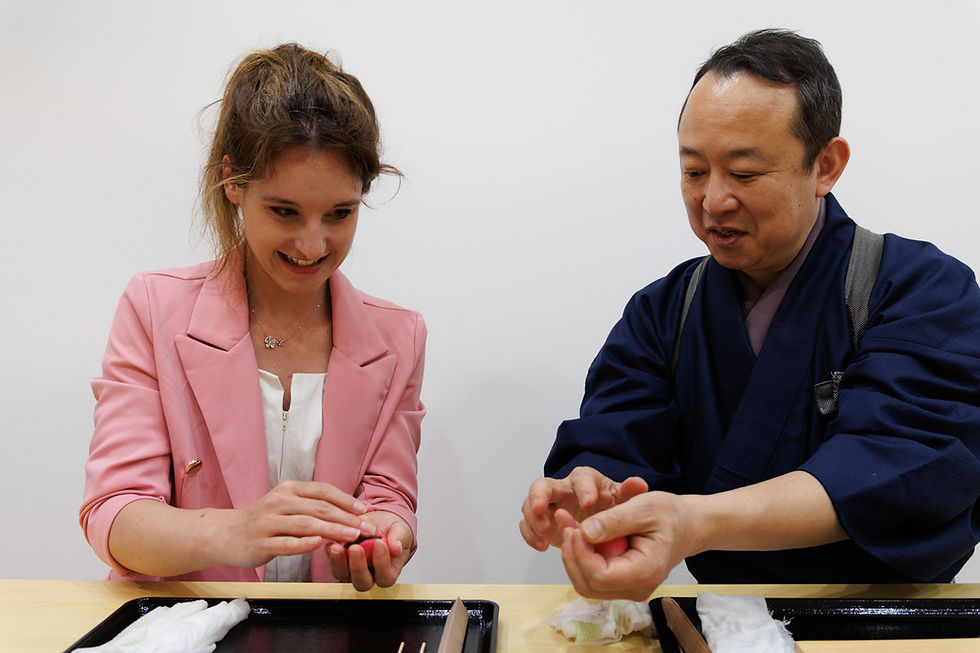
Learn the cultural significance of Children's Day while making kashiwa mochi by hand, then enjoy your creation alongside a bowl of chilled matcha in a private tea ceremony setting. This workshop consistently ranks among the most beloved experiences for international visitors to Kagurazaka.
For those seeking something truly rare, the post-Golden Week calendar opens up for fully private, reservation-based performances. Options include hokan(幇間) — traditional Japanese banquet entertainment performed by professional male entertainers, Tezuma (手妻, classical Japanese conjuring — the elegant forerunner of Western stage magic), and gagaku (ancient imperial court music). These experiences are available by prior arrangement. Please contact us to discuss availability and programming.

Who Should Visit Tokyo in May?
Repeat visitors to Japan who have experienced the cherry blossoms and are ready to discover what lies beneath the surface of Japanese culture.
Discerning travelers who value authenticity over spectacle, and who prefer to find a city's soul rather than simply see its sights.
Couples and families marking a special occasion — a honeymoon, an anniversary, a milestone birthday — who want experiences that go far beyond the standard tourist itinerary and become stories worth telling for years.
Tokyo in May holds a rare and precious balance: lively enough to feel the pulse of one of the world's great cities, quiet enough to find its soul. The festivals are extraordinary, the flowers are in their second spectacular act, and in the cobblestone lanes of Kagurazaka, a version of Japan that most visitors never find is waiting — unhurried, unscripted, and absolutely unforgettable.
Start planning your Tokyo in May journey today. We would love to help you make it extraordinary.
Travel Guide in Tokyo
Book Each Experience
How to Access Kagurazaka
The Kagurazaka area is conveniently located within 30 minutes from any major station in Tokyo. This is because Kagurazaka is situated in the heart of Tokyo, at the center of the Yamanote Line. Please come and visit this convenient and charming Kagurazaka.


Comments